Leading One Conversation at a Time
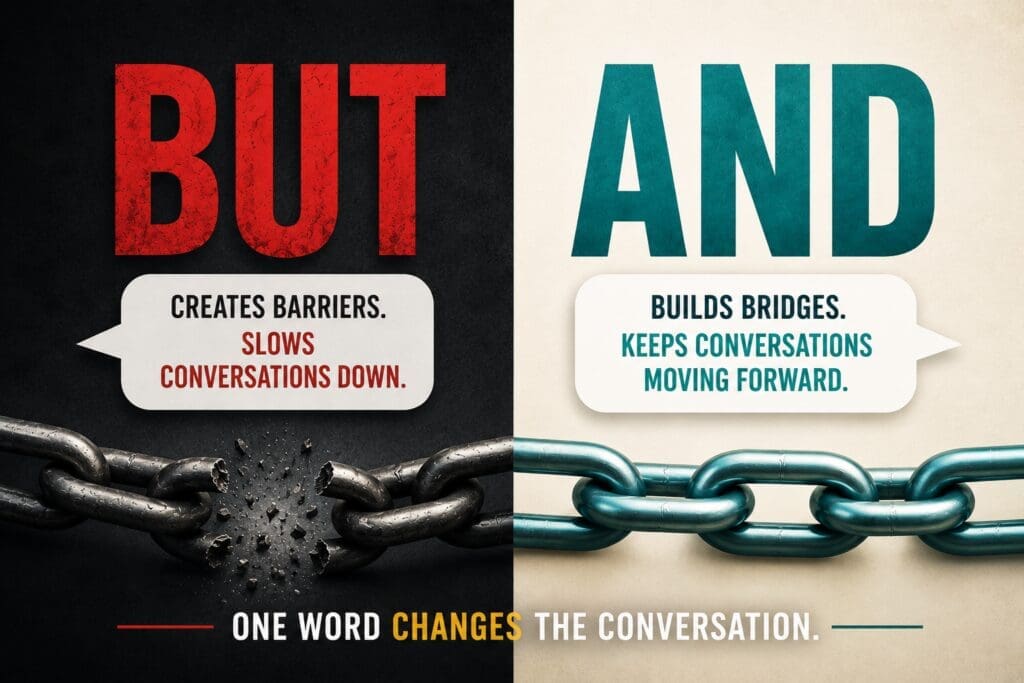
Some communication breakdowns don’t happen because leaders lack good intent.
They happen because of one small, familiar word.
But.
It shows up everywhere:
- “I hear what you’re saying, but…”
- “I appreciate your effort, but…”
- “That makes sense, but…”
And almost every time, it quietly undoes the very connection the speaker was trying to build.
What makes “but” so powerful, and so problematic, is that it tends to erase whatever came before it. If the first part of the sentence was positive, validating, or affirming, most people don’t hold onto that. Their attention locks onto whatever comes after the “but,” because that’s what feels most important, corrective, or threatening.
There’s a simple alternative, one that doesn’t water down the message, avoid accountability, or sugarcoat reality.
That word is and.
Why This Small Shift Matters More Than You Think
Let’s start with an uncomfortable truth:
When most people hear the word but, they stop listening.
Not consciously. Not dramatically. But internally, something shifts. Their body tightens. Their mind prepares a response. Their attention moves from understanding to self-protection.
Even when the first part of the sentence is genuine, the second part, introduced by but, feels like a correction, a dismissal, or a quiet override.
What “but” often communicates is:
“Everything I just said doesn’t matter; here’s what really matters.”
And does something different.
“And” allows two truths to exist at the same time.
It doesn’t erase what came before; it builds on it.
That subtle difference can change the entire emotional temperature of a conversation.
A Story You’ve Probably Lived (Even If You Don’t Realize It)
A leader once came to me after a conversation that hadn’t gone the way they hoped.
“I thought I started well,” they said. “But the moment I got into it, everything shifted. They shut down. The rest of the conversation felt tense.”
Instead of focusing on the employee’s reaction, we replayed the opening together.
They told me how they began:
“I really value your dedication and the way you support the team, but we need to talk about your attendance.”
At first, they didn’t notice anything unusual. It sounded responsible, even supportive.
So I asked them to say it again. Slowly.
Then I asked, “What do you think the employee heard?”
There was a pause.
We talked about how the word but, ” especially in moments like this, has a way of erasing what comes before it. How it subtly tells the listener which part matters most.
Then I asked another question: What if both things are true?
They nodded. They did value the employee’s dedication.
And they did need to address attendance.
So, we rescripted the opening:
“I really value your dedication and the way you support the team, and we need to talk about your attendance.”
Same facts. Same accountability.
A very different starting point.
They didn’t leave discouraged. They left clearer about how small language choices shape how people hear us, especially in moments that already feel vulnerable.
What “And” Actually Communicates
Using “and” instead of “but” sends a few powerful signals, often without the speaker realizing it.
- The first part of the message still matters.
The acknowledgment isn’t erased by what comes next. - We can hold complexity
Life isn’t either/or. Leadership rarely is.
When both parts of a statement are true, connecting them with “and” communicates exactly that: both realities can exist at the same time. One doesn’t invalidate the other. - This is a conversation, not a verdict
It keeps dialogue alive instead of shutting it down.
This is especially important in environments where emotions already run high, and trust is fragile.
Practical Examples (Because This Has to Work in Real Life)
Here’s how this shift looks in everyday leadership conversations:
- “I heard you say you are frustrated, and we still have to follow the process.”
- “You’ve made real progress, and there are a couple of areas we need to improve on.”
- “I hear your concern regarding the workload, and I’d like to share another perspective.”
In each of these examples, both statements are true. “And” allows you to acknowledge that truth without forcing the other person to choose which part of the message matters more.
Notice what doesn’t change:
- Expectations
- Boundaries
- Accountabilty
What does change is how safe the other person feels while hearing them.
This Isn’t About Being Nice, It’s About Being Effective
Some leaders worry that using “and” will make them sound weak and indecisive.
In reality, the opposite is true.
“And” requires confidence. It says:
“I’m strong enough to acknowledge you and stand my ground.”
It’s a leadership move, not a people-pleasing one.
Clear expectations delivered without relational damage are far more likely to be heard, remembered, and acted on.
Where This Shows Up Most (and Causes the Most Damage)
Pay attention to how often “but” shows up in:
- Feedback conversations
- Conflict resolution
- Policy enforcement
- Resident or tenant interactions
- Performance discussions
These are often moments where leaders intend to soften the message with something positive, but inadvertently erase it with “but.”
These are also moments where people are already bracing themselves.
“And” lowers the shield just enough for real listening to happen.
A Simple Practice to Build the Habit
Here’s a low-effort way to start using this immediately:
For one week, notice, but don’t judge, how often you say “but.”
Then ask yourself:
- “What would happen if I replaced this with ‘and’?”
- “Are both parts of this statement true, and am I unintentionally erasing one of them?”
You don’t need to eliminate “but” entirely.
You just need to become intentional about when and why you use it.
Your Call to Action
This week, choose one conversation, just one, where you consciously replace “but” with “and.”
Pay attention to what changes:
- How the conversation feels.
- How the other person responds.
- How much resistance rises, or doesn’t
Small shifts compound.
If conversations are part of your leadership role, and they are, small communication choices matter more than most people realize. And sometimes meaningful change starts with something surprisingly simple.
One word.
One pause.
One different response.
If you found this helpful, you can find more practical leadership and communication tools at garyharrelson.com or connect with me directly at gary@garyharrelson.com.
Because leadership isn’t just about getting the message across.
It’s about helping people stay open enough to hear it.


Be the first to comment