Leading One Conversation at a Time
A resident walks into the office with a simple question.
“Do you know when maintenance is coming to look at my sink?”
On the surface, this seems like a straightforward, transactional interaction.
The resident needs information.
You provide information.
Conversation complete.
Except…not entirely.
Because underneath that practical exchange, something else is usually present.
The resident also has a personal need.
Not necessarily a big emotional need. Not a crisis. Not conflict.
But a human need.
The need to be heard.
The need to be treated respectfully.
The need to feel that their question matters.
We often notice these needs most clearly in difficult conversations.
But the truth is:
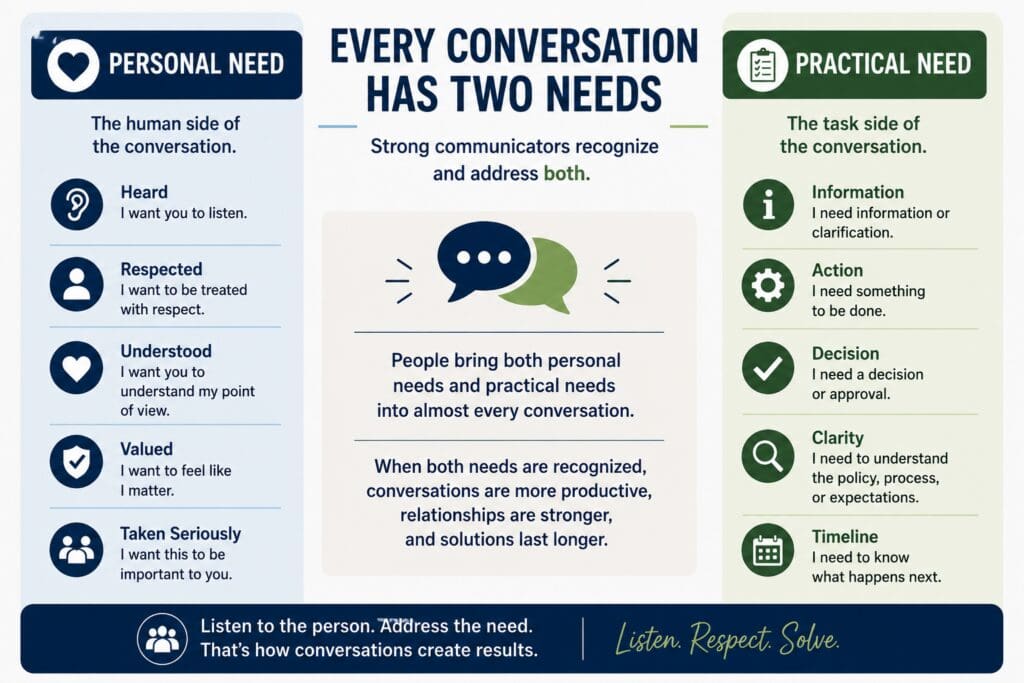
Personal and practical needs exist in almost every conversation.
And strong communicators learn to recognize both.
Two Things People Bring Into Conversations
Whether you’re speaking with a resident, an employee, a vendor, or a colleague, people typically bring two kinds of needs into the interaction.
Practical Need
This is the task side of the conversation.
People may need:
- Information
- Action
- A decision
- Clarification
- A solution
- Direction
- A timeline
These are usually the most visible needs.
- “Can maintenance look at this?”
- “What’s the policy?”
- “When will this be resolved?”
- “Can you approve this request?”
Personal Need
This is the human side of the conversation.
People often want to feel:
- Heard
- Respected
- Understood
- Valued
- Taken seriously
Even when the conversation is brief.
Even when it is routine.
Even when it is purely transactional.
The Everyday Transactional Conversation
Imagine a resident asks:
“Can you tell me why my statement looks different this month?”
One response might be:
“It’s because of the annual adjustment. It’s on the notice that went out.”
The practical need is addressed.
The information was given.
But compare that with:
“Absolutely. I can help with that. A lot of people have had questions about the change. Let’s take a look together.”
Both responses provide information.
Only one more intentionally addresses the personal side of the interaction.
Not because the resident is emotional.
Not because conflict exists.
Because people generally respond well when they experience dignity and respect inside a conversation.
Why This Matters for Site and Property Managers
Affordable housing leaders operate in an environment full of conversations.
Resident conversations.
Team conversations.
Vendor conversations.
Owner conversations.
Quick hallway conversations.
Email conversations.
Phone conversations.
Some are transactional.
Some are emotionally charged.
Some shift unexpectedly from routine to difficult in a matter of seconds.
Understanding personal and practical needs gives leaders a simple lens for reading what is happening underneath the interaction.
It helps explain why two leaders can deliver the same answer and receive very different reactions.
The difference is not always the content.
Sometimes it is the experience of the conversation.
When Emotions Enter the Room
This framework becomes even more important when emotions are involved.
Consider a maintenance technician who says:
“I’m getting pulled in five directions today.”
The practical need may be staffing support, prioritization, or workload clarification.
But the personal need may be just as important:
“I need you to understand the pressure I’m carrying.”
Or a resident says:
“I’ve called twice already.”
The practical need may be action on a work order.
The personal need may be:
“I need to know this matters.”
In emotionally charged conversations, personal needs often become louder.
If those needs are ignored, people may struggle to hear what you’re saying, consider possible solutions, or move toward problem-solving.
But this isn’t a framework only for difficult conversations.
It is a framework for everyday leadership communication.
A Simple Question for Better Conversation
The next time you are in a conversation, whether it is routine or challenging, pause and ask:
What is the practical need?
What does this person need from me?
What is the personal need?
How does this person need to experience this conversation?
You do not need perfect words or long conversations to recognize both needs.
Often it looks like:
- “Good question.”
- “Thanks for bringing that up.”
- “Let’s look at it together.”
- “I can understand why you’d want clarity on that.”
- “Help me understand.”
Small responses.
Big impact.
The Bottom Line
People rarely come into conversations carrying only tasks.
They usually bring both practical needs and personal needs.
Strong communicators learn to recognize both.
Because communication is not only about solving problems or delivering information.
It is also about how people experience the interaction itself.
And whether the conversation lasts thirty seconds or thirty minutes, most people want more than an answer.
They want to feel respected while receiving it.
Continue the Conversation
Want more practical tools to help you communicate clearly, navigate challenging conversations, and lead with confidence?
Visit GaryHarrelson.com for leadership resources, communication insights, and practical tools for real-world conversations.


Be the first to comment