Leading One Conversation at a Time
“I’ve already told three people about this.”
The resident’s voice echoes through the office.
Other residents waiting nearby glance up.
You can feel the frustration.
The maintenance issue is real, and the resident wants answers. You want to help, but you also need the conversation to remain productive.
Then the resident interrupts again.
You feel your own frustration rising.
If you’ve worked in affordable housing for any length of time, you’ve probably experienced a conversation like this.
What started as problem-solving suddenly became a conversation about tone, attitude, and respect.
The challenge for site and property managers is not whether to address the behavior. The challenge is how to address it without creating defensiveness.
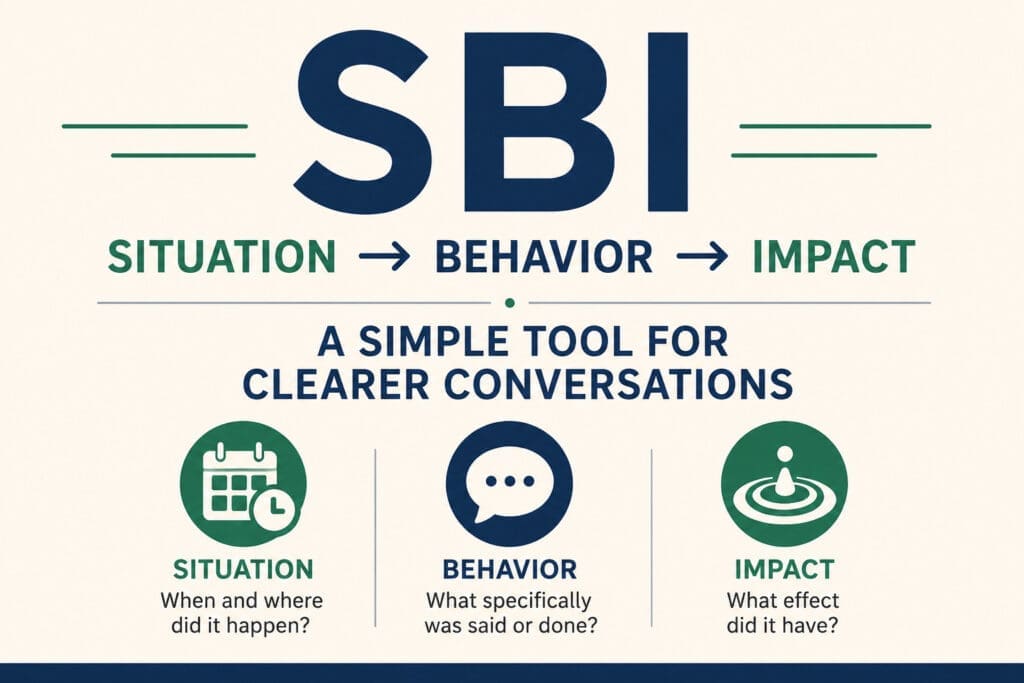
One tool that can help is SBI: Situation, Behavior, Impact.
Why Difficult Conversations Go Sideways
Many difficult conversations become harder because we skip straight to conclusions.
We describe what we think the other person is rather than what they did.
For example:
“You’re being disrespectful”
Or:
“You have a bad attitude.”
Or:
“You’re not listening.”
While those statements may reflect our experience, they are also likely to trigger defensiveness.
Why?
Because they focus on identity and intent rather than observable behavior.
The conversation quickly shifts from solving the issue to debating whether the label is true.
That’s where SBI can help.
What is SBI?
SBI stands for:
Situation – When and where did it happen?
Behavior – What specifically was said or done?
Impact – What effect did it have?
The framework helps leaders communicate concerns clearly while reducing assumptions, judgments, and generalizations.
S = Situation
Start with the specific situation
Not:
“You always…”
Not:
“Every time I talk to you…”
Instead, identify the specific moment.
For example:
“During our conversation this morning about your maintenance request…”
Or:
“When we met in the office yesterday afternoon…”
This simple step helps both people focus on the same event.
Specificity creates clarity.
B = Behavior
Next, describe the behavior you observed.
Focus on what was said or done, not your interpretation of it.
Compare these examples.
Less Helpful
“You were rude.”
More Helpful
“You interrupted me several times and raised your voice.”
The first statement is a judgment.
The second statement is an observation.
One invites an argument.
The other creates clarity.
One of the most valuable communication skills a leader can develop is learning to separate observation from interpretation.
I = Impact
Finally, explain the impact.
What effect did the behavior have?
For example:
“It made it difficult for me to fully understand your concern.”
Or:
“It made it harder for us to work toward a solution together.”
Or:
“Other residents in the waiting area appeared uncomfortable.”
Impact answers an important question:
Why does this matter?
Not because someone is “good” or “bad.”
Not because someone is “right” or “wrong.”
But because behavior affects communication, relationships, and outcomes.
What SBI Can Sound Like
Let’s put all three pieces together.
Instead of:
“You need to stop being disrespectful.”
Try:
“During our conversation this morning about your maintenance request (Situation), you interrupted several times and raised your voice (Behavior). I found it difficult to fully understand your concerns and work toward a solution with you (Impact).”
Notice what changed.
The manager is still addressing the behavior.
The accountability remains.
The issue isn’t ignored.
The message is simply clearer.
And clear communication often lowers defensiveness.
How SBI Works With Other Communication Tools
If you’ve read some of my previous articles, you may notice that SBI connects naturally with other communication skills.
For example, in “The Two Needs Behind Almost Every Conversation,” I discussed how people often bring both personal and practical needs into a conversation. SBI helps managers address behavior clearly while still acknowledging a resident’s need to feel heard and understood.
Likewise, The Small Communication Shift That Changes Difficult Conversations explores how “I” statements often reduce defensiveness. SBI and “I” statements work well together because both focus on observations and impact rather than blame and judgment.
While each of these tools serves a different purpose, they all support the same goals: creating more productive, respectful, and solution-focused conversations.
A Practical Reminder
SBI is not a script.
It’s a guide.
You don’t need to memorize it.
You don’t need to use the exact words every time.
The goal is simply to make a shift:
From assumptions to observations.
From labels to examples.
From blame to clarity.
The next time you find yourself preparing for a difficult resident conversation, ask yourself three questions:
- What was the specific situation?
- What behavior did I observe?
- What impact did it have?
Those questions can help you communicate concerns in a way that promotes understanding rather than defensiveness.
And sometimes that small shift can change the difference between a conversation that escalates and one that moves toward a solution.
Continue the Conversation
Difficult conversations are part of every leadership role. The good news is that communication skills can be learned and strengthened over time.
If you found this article helpful, explore other resources on communication, conflict, and leadership at GaryHarrelson.com.
You’ll find practical tools designed to help you navigate challenging conversations with greater clarity and confidence.
NOTE. The SBI model was first described by the Center for Creative Leadership. More information about SBI can be found at their website, www.ccl.org.


Be the first to comment