Leading One Conversation at a Time
“I don’t know what else to do.”
The words hung in the air as the employee leaned back in the chair.
“I’ve tried everything. I’ve talked to my team; I’ve worked longer hours. I take work home almost every night, and I still feel like I’m letting everyone down.”
As a leader, your instinct is probably the same as mine.
You want to help.
You want to reassure them.
You want to solve the problem.
So it’s tempting to respond with something like:
“I’m sorry you’re going through this.”
There’s nothing wrong with those words. They come from a place of genuine concern.
But what if the person sitting across from you doesn’t need reassurance yet?
What if they’re really asking:
“Does anyone understand what this feels like?”
The best leaders I’ve worked with don’t rush to solve the problem. They first make sure the other person feels understood.
That’s empathy.
I’ve become convinced that empathy is one of the most powerful leadership skills we can develop, not because it’s kind, but because it creates the conditions where productive conversations become possible.
🎧 Prefer to Listen?
Hear the audio version of this article — I’ll read it in full, then go Beyond the Blog, where I share a story, answer a common question, or offer a practical insight that didn’t make it into the written piece.
Why Feeling Understood Comes First
Think about the last time you were frustrated.
Maybe someone interrupted before you finished explaining. Maybe they started offering advice before they understood what had happened.
How did that feel?
Probably not very helpful, and maybe a little frustrating.
Most people don’t resist solutions because they don’t want help. They resist them because they don’t yet feel understood.
In a previous article, I wrote that almost every conversation contains two needs.
The practical need is the issue that eventually must be addressed.
The personal need is equally important, and more human: people want to feel heard, respected, and like their perspective matters.
Empathy is one of the primary ways we address that personal need.
When leaders address the person side of the conversation first, the practical conversation often becomes much easier.
A Different Definition of Empathy
Empathy is sometimes described as a personality trait.
I don’t see it that way.
I believe empathy is a leadership skill, which means it can be learned.
More specifically:
Empathy is the leadership skill of helping another person feel understood, so productive conversations become possible.
Notice what that definition doesn’t say.
Empathy isn’t agreement.
It isn’t lowering expectations.
It isn’t taking responsibility for someone else’s emotions.
It is helping another person feel understood.
People don’t trust leaders because those leaders always have the right answers. They trust leaders who care enough to understand before trying to solve the problem.
The Empathy Path
Over time, I’ve noticed that productive conversations tend to follow the same pattern. I now think of it as The Empathy Path.
Rather than rushing to solve the problem, effective leaders intentionally move through four steps.
- Acknowledge the Person’s Experience
- Help Them Feel Understood
- Emotional Intensity Decreases
- Work Together to Find a Solution
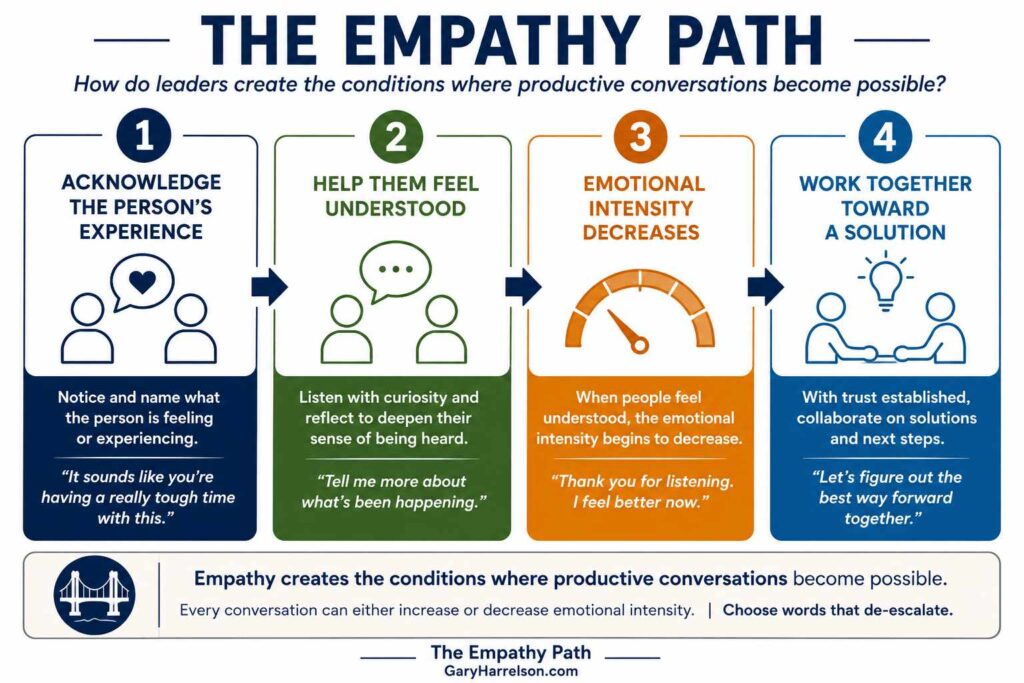
Here’s what each step actually looks like.
Acknowledge the experience. This is as simple as naming what you’re seeing, out loud: “It sounds like you’ve been carrying a lot.”
You’re not diagnosing or agreeing; you’re letting them know you noticed.
Help them feel understood. Acknowledging is a single sentence; feeling understood is a conversation.
This is where you ask, you listen, and you reflect back what you’re hearing until they confirm you’ve got it. I’ll often ask directly: “Do you feel like I understand you?”
If the answer is no, I’m not ready to move forward, I stay right there and get curious about what they believe I don’t understand.
Let emotional intensity decrease. You don’t force this step; you wait for it.
When people feel heard, their nervous system starts to settle down on its own. You’ll notice it: the pace of their speech slows, their shoulders drop, the conversation gets quieter.
Work together to find a solution. Only now do you turn to the practical need.
Notice the word together; this step works because the first three made it a shared problem instead of a lecture.
Many conversations go sideways because we begin with step four. We offer advice, explain a decision, or propose a solution before the other person feels heard.
Meanwhile, they may still be wondering, “Do you understand what this has been like for me?” Until that question is answered, even a good solution can feel premature.
Empathy Isn’t an Emotion
A common misconception is that empathy requires exactly what someone else feels.
I disagree.
Empathy allows me to enter another person’s experience without losing my perspective.
If someone is overwhelmed, I don’t have to become overwhelmed.
If they’re angry, I don’t have to become angry.
Leaders are most helpful when they remain calm enough to understand another person’s experience without being consumed by it themselves.
Empathy isn’t taking on another person’s emotions. It is being present with those emotions while keeping the perspective needed to guide the conversation forward.
Empathy vs. Sympathy
People often use empathy and sympathy interchangeably.
I don’t.
Here’s the distinction I use when teaching leaders:
Sympathy acknowledges the problem.
Empathy acknowledges the person’s experience.
Imagine someone says: “I’m completely overwhelmed trying to keep up with everything.”
A sympathetic response: “I’m sorry you’re dealing with that.”
An empathic response: “It sounds like you’re carrying a tremendous amount right now.”
Do you hear the difference?
One responds to the situation.
The other responds to the person.
One of my favorite definitions of empathic listening is:
Listening with the intent to understand how the speaker feels, in addition to understanding their ideas.
Leaders aren’t just listening for facts; we’re listening for concerns, emotions, and what matters most to the person in front of us.
That is how we help people feel understood.
Three Ways Leaders Accidentally Skip the Path
If empathy is such an effective skill, why is it hard to practice consistently? In my experience, it isn’t because leaders don’t care. It’s because we fall into one of three traps.
Moving too quickly to solutions. Leaders are problem-solvers; that’s one of our greatest strengths and one of our greatest temptations.
When emotions are running high, jumping to a fix can unintentionally say:
“I hear your problem, but I didn’t really hear you.”
Once people feel understood, they’re usually far more willing to discuss solutions.
Minimizing the person’s experience. We rarely do this on purpose; we’re usually trying to help.
We say things like:
“It’ll be okay.”
“Don’t worry about it.”
“At least…”
The intention is reassurance; the impact is often the opposite. It tells the person their experience is smaller than they believe it is.
Sometimes the most helpful response is simply:
“That sounds incredibly frustrating.”
Making the conversation about ourselves. Someone shares a hard experience, and a few seconds later we’re telling them about something similar that happened to us.
Sometimes that builds connection. More often, it shifts the focus away from the person who needs it most.
Instead of “That happened to me once…” try “Tell me more.” Curiosity beats comparison almost every time.
Try This This Week
In your next conversation, before explaining, defending, or solving, ask yourself:
Have I helped this person feel understood?
If the answer is no, try one of these:
- “Help me understand what’s been happening.”
- “It sounds like you’re carrying a lot right now.”
- “That seems [frustrating/disappointing/exciting/etc.], is that right?
- “Tell me more.”
Then do the harder part: listen.
Not to formulate your response.
Not to prepare your defense.
Not to decide what you’ll say next.
Listen to understand.
You may be surprised how often the conversation starts moving toward a solution on its own.
A Quick Check Before You Respond
Before moving forward in a difficult or emotional conversation, ask yourself:
- Am I rushing to solve the problem?
- Am I minimizing this person’s experience?
- Am I making the conversation about me?
If you answer yes to any of those:
- pause,
- get curious, and
- help the other person feel understood before you move forward together.
One Conversation at a Time
Maya Angelou famously said, “People will forget what you said and did, but never how you made them feel.”
I believe that’s especially true for leaders.
They rarely forget whether they left a conversation feeling respected or dismissed.
Understood or judged.
Valued or ignored.
That’s why The Empathy Path matters.
Trust isn’t built because leaders always have the right answers.
It’s built because people believe their leader genuinely wanted to understand them before trying to solve the problem.
The next time you are in a conversation, difficult or not, remember the path:
Acknowledge. Understand. Let the intensity settle. Then solve it together.
Empathy is more than a communication skill.
It’s a leadership skill.
It’s a de-escalation skill.
And it’s one of the most effective ways I know to create the conditions where productive conversations become possible.
One conversation at a time.
Continue the Conversation
Every week, I share a practical framework you can use immediately- no theory, just tools that work in real conversations.
Click here to subscribe and get the next one delivered straight to your inbox.


Be the first to comment